
Should We Be Splinting Adjacent Implants?
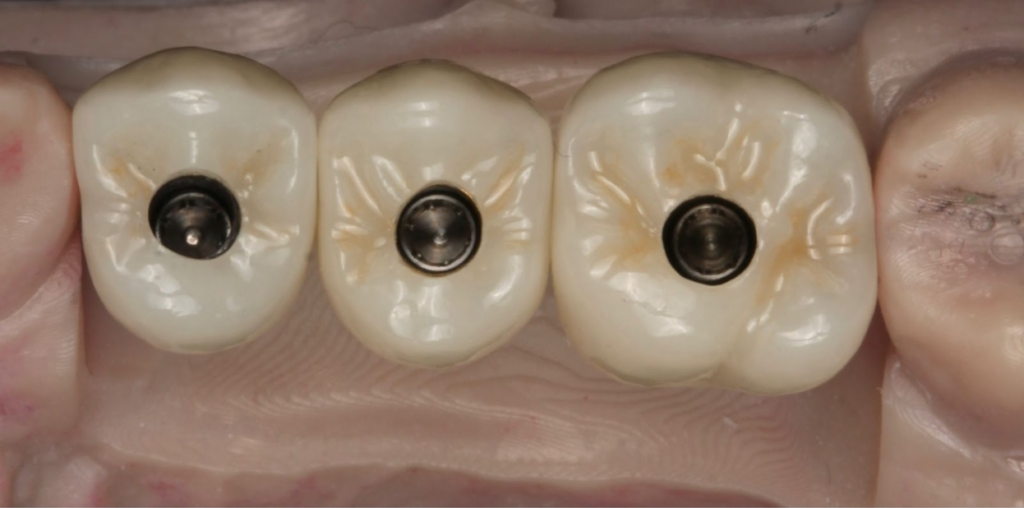
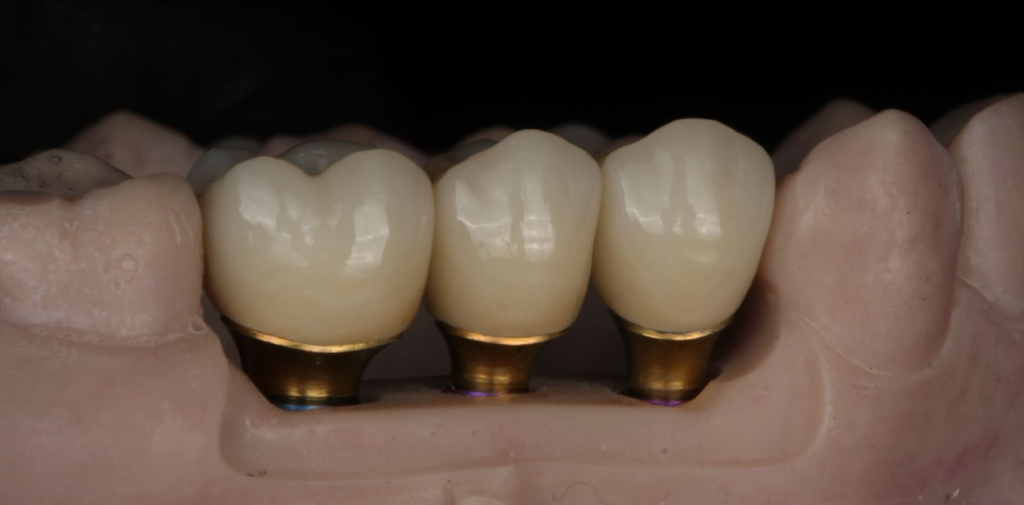
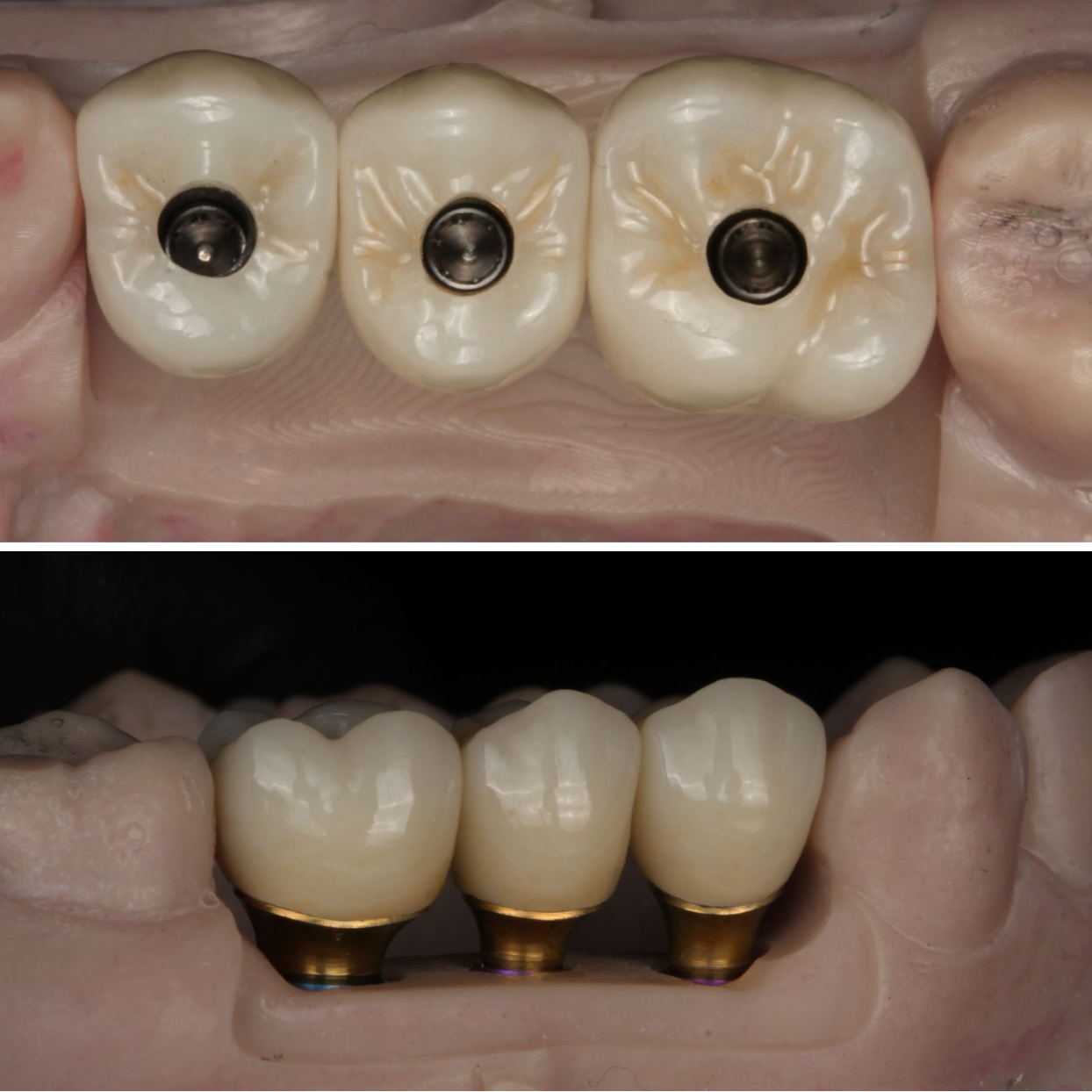
This is a question I get asked frequently — by colleagues, by residents, and by referring dentists. Should we be splinting adjacent implants? The short answer is that in the majority of clinical scenarios, no. And the evidence is clear on this.
For decades, the default teaching in prosthodontics has been to splint adjacent implants to “distribute occlusal forces” and “protect marginal bone.” It sounds logical. It makes biomechanical sense on paper. But when you look at the clinical evidence — including high-level evidence such as randomized controlled trials, systematic reviews, and meta-analyses — the data does not support routine splinting of adjacent implants.
What Does the Evidence Tell Us?
The strongest single piece of evidence we have is a 10-year randomized controlled trial by Vigolo et al. (2015), published in the International Journal of Oral & Maxillofacial Implants. They placed 132 implants in 44 patients, all in the posterior maxilla, using a split-mouth design — splinted on one side, nonsplinted on the other. At 10 years, the splinted group showed 1.2 mm of mean bone loss. The nonsplinted group showed 1.3 mm. A difference of 0.1 mm. Statistically significant, but clinically meaningless. No difference in implant survival.
That finding has been confirmed repeatedly. de Souza Batista et al. (2019) in the Journal of Prosthetic Dentistry pooled 19 studies covering 4,215 implants and found no significant differences in marginal bone loss or prosthetic complications between splinted and nonsplinted restorations. Pascoal et al. (2025), also in JPD, conducted a more recent meta-analysis of 2,085 implants and again found no statistical differences in biological complications. The evidence is consistent, and it keeps growing.
The 2025 AO/AAP Systematic Review
The paper I want to highlight in particular is the 2025 systematic review and meta-analysis by Lin, Barootchi, Wang, and colleagues, published in the Journal of Periodontology and commissioned by the Academy of Osseointegration and the American Academy of Periodontology. This was not a narrow review. It was a comprehensive analysis of how prosthetic design factors influence peri-implant marginal bone loss, incorporating 93 studies published between 1980 and 2023.
Their finding on splinting was striking: nonsplinted implants actually exhibited lower marginal bone loss than splinted implants across eight included studies (p = 0.04). The data did not just show equivalence — it favored nonsplinted restorations. The review also found that crown-to-implant ratio did not significantly affect marginal bone loss (p = 0.32), which challenges another piece of conventional wisdom often cited as a reason to splint.
Among their conclusions: platform switching, adequate abutment height (≥2 mm), internal conical connections, and one-abutment-one-time protocols all had significant protective effects on peri-implant bone. Splinting was not among the protective factors. If anything, it was associated with worse outcomes.
When organizations at the level of the AO and AAP publish a meta-analysis concluding that nonsplinted implants demonstrate better peri-implant bone outcomes, we should pay attention.
Clinical Advantages of Not Splinting
Beyond the bone-level data, there are practical clinical advantages to individual restorations on adjacent implants that are worth understanding.
Hygiene access. Individual crowns allow patients to floss normally and use interdental brushes without navigating around connectors. Yi et al. (2020), publishing in the Journal of Clinical Periodontology, showed a 4.66-fold increase in peri-implantitis risk for middle implants in 3-unit splinted designs compared to individually restored implants. In a subsequent 15-year retrospective study, Yi et al. (2023) in IJOMI reported biological complications in 45.4% of splinted versus 26.4% of nonsplinted implants across 888 implants — with the middle splinted implant again carrying the highest risk. The likely driver is limited access for oral hygiene. We cannot design restorations that patients cannot clean and expect healthy peri-implant tissues.
Passive fit. This is a big one. Achieving truly passive fit across a multi-unit splinted framework remains one of the most technically demanding aspects of implant prosthodontics. Even with modern digital workflows, misfit introduces residual stress at the bone-implant interface. Prete et al. (2024), publishing in Clinical Advances in Periodontics, showed that vertical platform discrepancies between splinted adjacent implants — even discrepancies as small as 0.5 mm — were associated with increased crestal bone loss, particularly on the middle implant. Individual crowns eliminate this variable entirely. Every unit seats to its own implant. No framework distortion. No residual stress.
Retrievability. When a complication arises on one implant — whether a porcelain fracture, screw loosening, or peri-implantitis requiring surgical intervention — you deal with that single restoration without disturbing adjacent units. With a splinted prosthesis, a problem on one unit often means removing the entire restoration. More chair time, more cost, more risk.
Are the “Traditional” Indications for Splinting Evidence-Based?
Many of us were taught that splinting is indicated for short implants, compromised bone, and unfavorable crown-to-implant ratios. These recommendations have been repeated so often they feel like established fact. But when you trace them back to their source, the clinical evidence does not necessarily tell the same story.
Short implants: Li et al. (2022) published a systematic review in the Journal of Prosthodontics examining 1,506 short implants (≤8.5 mm) and concluded that splinting did not demonstrate superior survival, bone maintenance, or mechanical complication prevention compared to nonsplinted restorations.
Crown-to-implant ratio: As discussed above, the AO/AAP review by Lin et al. found no significant relationship between crown-to-implant ratio and marginal bone loss (p = 0.32). This directly challenges one of the most commonly cited justifications for splinting.
Compromised bone quality: This recommendation is largely extrapolated from finite element analysis studies and theoretical biomechanics. I have not found clinical trial evidence demonstrating that splinting improves outcomes in these patients.
These “indications” are rooted in expert opinion and mechanical reasoning — not in clinical data. That does not mean there is never a scenario where splinting makes sense. Cantilever situations, full-arch rehabilitations, and cases with significant prosthetic complexity may still warrant a splinted approach. But those are specific clinical situations with their own rationale — not a blanket justification for routinely splinting adjacent implants in standard partially edentulous cases.
The Bottom Line
The evidence is telling us something, and I think it is time we listen. Splinting adjacent implants in standard clinical scenarios — adequate bone, appropriate implant dimensions, favorable occlusion — is not supported by the literature. The best available evidence shows equivalent or even superior outcomes with individual restorations, with added benefits of hygiene access, passive fit, and retrievability. It is time to move past the biomechanical dogma and let the clinical data guide our treatment planning.
References
1. Vigolo P, Mutinelli S, Zaccaria M, Stellini E. Clinical evaluation of marginal bone level change around multiple adjacent implants restored with splinted and nonsplinted restorations: a 10-year randomized controlled trial. Int J Oral Maxillofac Implants. 2015;30(2):411-418.
2. de Souza Batista VE, Verri FR, Lemos CAA, et al. Should the restoration of adjacent implants be splinted or nonsplinted? A systematic review and meta-analysis. J Prosthet Dent. 2019;121(1):41-51.
3. Pascoal ALB, Paiva KRG, Marinho LCN, Bezerra ADS, Calderon PDS. Impact of splinting implant-supported crowns on the performance of adjacent posterior implants: A systematic review and meta-analysis. J Prosthet Dent. 2025;133(2):402-410.
4. Lin GH, Lee E, Barootchi S, Rosen PS, Curtis D, Kan J, Wang HL. The influence of prosthetic designs on peri-implant bone loss: An AO/AAP systematic review and meta-analysis. J Periodontol. 2025;96(6):634-651.
5. Yi Y, Koo KT, Schwarz F, Ben Amara H, Heo SJ. Association of prosthetic features and peri-implantitis: A cross-sectional study. J Clin Periodontol. 2020;47(3):392-403.
6. Yi Y, Heo SJ, Koak JY, Kim SK, Koo KT. Splinting or nonsplinting adjacent implants? A retrospective study up to 15 years: Part I — Biologic and mechanical complication analysis. Int J Oral Maxillofac Implants. 2023;38(3):435-442.
7. Prete A, et al. A pattern of peri-implantitis affecting middle implants in 3-implant splinted prostheses. Clin Adv Periodontics. 2024.
8. Li QL, Yao MF, Cao RY, Zhao K, Wang XD. Survival rates of splinted and nonsplinted prostheses supported by short dental implants (≤8.5 mm): A systematic review and meta-analysis. J Prosthodont. 2022;31(1):9-21.